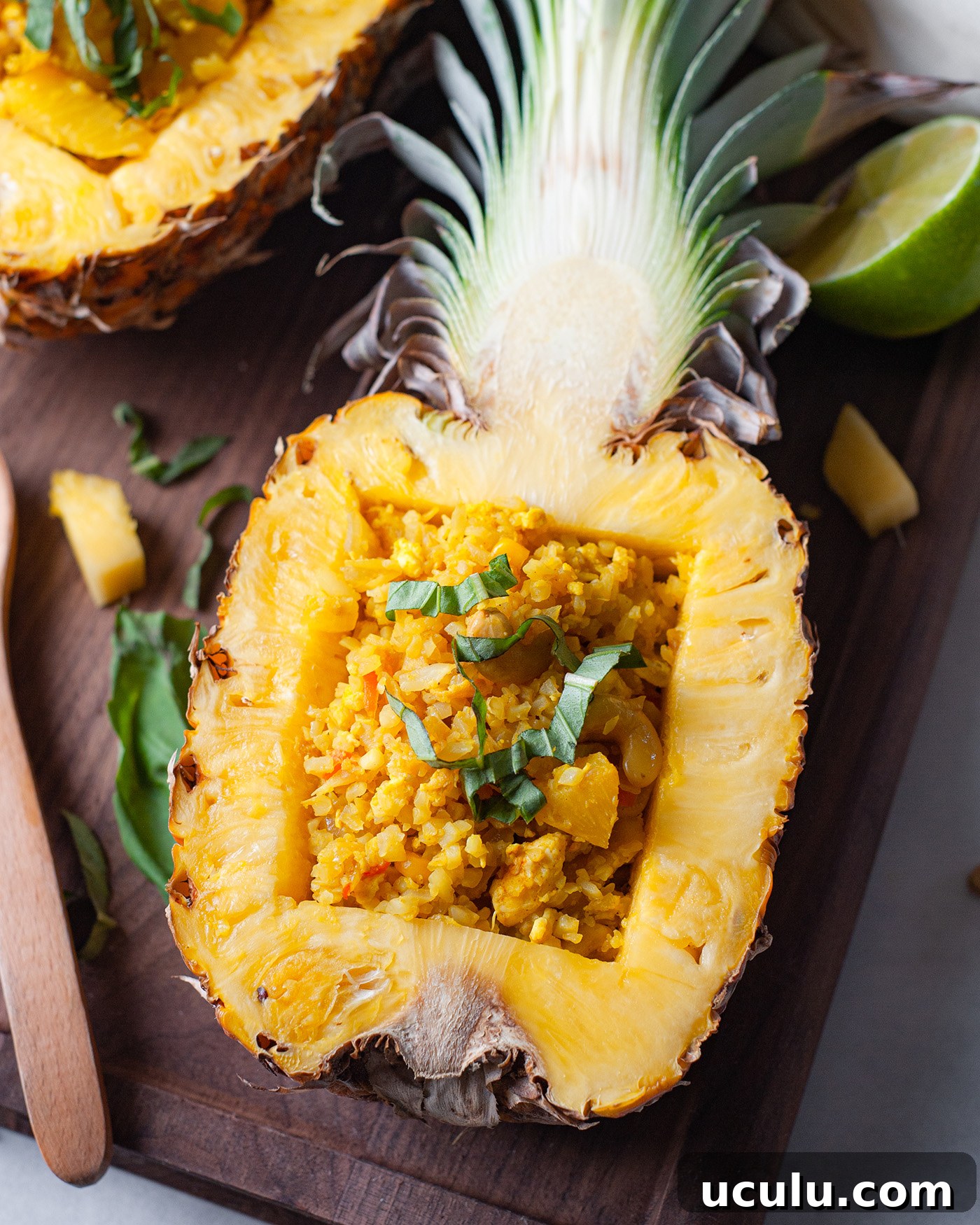
Today we’ll show you how to make Cauliflower Pineapple Fried Rice, served inside a pineapple bowl. It’s a fun, healthy twist on a classic Thai-style dish that’s simple to prepare at home.
Cauliflower Pineapple Fried Rice is a lighter take on Thai pineapple fried rice (khao op sapparot). We stir-fry riced cauliflower with fresh pineapple, garlic, onion, cashews, eggs, and a few seasonings for a vibrant, flavorful meal.
Get ready to impress friends and family with a colorful, satisfying dish. Read on for the full recipe and tips for success.
Table of Contents
- What is Cauliflower Pineapple Fried Rice?
- Why make Vegetarian Cauliflower Pineapple Fried Rice at Home
- Ingredients
- Pineapple Cauliflower Rice
- Garnish
- Suggestions for customization
- Recipe
- Carve the Pineapple Bowls
- Stir Fry the Rice
- Common Mistakes
- Final Thoughts
What is Cauliflower Pineapple Fried Rice?
Cauliflower Pineapple Fried Rice is inspired by the Thai dish khao op sapparot, a fried rice served inside a hollowed pineapple. The traditional version combines rice with eggs, garlic, onion, cashews, herbs, and often a protein such as chicken, pork, or shrimp. Limes are commonly served alongside for brightness.
In this version we replace jasmine rice with riced cauliflower for a lower-carb, lower-calorie alternative. Key ingredients include pineapple, cashews, garlic, onion, eggs, and bell pepper. A touch of turmeric gives the cauliflower rice a warm golden color.
The recipe is flexible — you can easily add or remove ingredients to suit your taste.
Why make Vegetarian Cauliflower Pineapple Fried Rice at Home
- Easy: This recipe uses a single pan or wok and straightforward ingredients. If you prefer, skip carving a pineapple and use pre-cut pineapple pieces.
- Healthy: Swapping rice for cauliflower cuts carbs and calories while keeping volume and flavor, making it a great option for lighter meal plans.
- Meal prep friendly: Make a larger batch for quick lunches or dinners. The cooked rice freezes well for up to two months.
- Customizable: Vegetarian and vegan variations are simple by swapping or omitting eggs and adding your preferred protein or vegetables.
- Great presentation: Serving the rice in a pineapple bowl elevates the dish and makes cauliflower rice exciting and flavorful.
Ingredients
Pineapple Cauliflower Rice
- 1 tbsp unsalted butter
- 1 whole pineapple
- 3 cloves garlic, chopped
- ½ cup yellow onion, chopped
- ¼ cup raw cashews
- ¼ cup frozen vegetable mix (we used corn & edamame)
- ¼ cup red bell pepper, chopped
- 3 cups cauliflower rice
- 3 eggs
- 1 tsp turmeric
- 3 tbsp brown sugar
- 1 tsp white pepper
- Vegetable oil for the pan
Garnish
- Chopped basil
- Wedges of lime
Suggestions for customization
- Grilled chicken or shrimp
- Raisins
- Tomatoes
- Thai chili pepper
- Cilantro
- Fish sauce (for additional umami)
Recipe
Carve the Pineapple Bowls
- Using a very sharp knife, cut the pineapple completely in half lengthwise.
- On each half, score the top and bottom borders by cutting straight down, deep enough to remove fruit but not through the skin.
- Score the left and right borders at a 45-degree angle without cutting through the skin.
- Cut horizontal and vertical lines to divide the pineapple flesh into bite-sized pieces.
- Scoop out the pieces and set aside. Chop any large chunks so they’re uniform.
- Trim excess flesh from the bowl walls without compromising the shell; reserve trimmed pieces for the stir-fry.
Stir Fry the Rice
- Heat a wok or nonstick pan over medium-high heat. Add butter and sauté the pineapple pieces for 7–10 minutes until they begin to caramelize.
- Add a small splash of oil, then add garlic and onion. Sauté until fragrant.
- Add cashews, frozen vegetables, and red bell pepper. Cook about 5 minutes, or until excess moisture has mostly evaporated.
- Add the cauliflower rice and cook until lightly browned, stirring frequently.
- Create a well in the center of the pan. Add beaten eggs to the center and let them set briefly, then scramble into small pieces and mix into the rice.
- Stir in turmeric first so the color distributes evenly, then add soy sauce, brown sugar, and white pepper. Toss and cook for an additional 3–5 minutes to blend flavors.
- Fill the pineapple bowls with the finished rice and serve topped with chopped basil and lime wedges.
Common Mistakes for Cauliflower Pineapple Fried Rice
- Cutting through the pineapple skin or hollowing out too much: If the bowl weakens, support it on a plate or in another bowl when serving.
- Using a dull knife: A sharp knife is safer and makes carving easier. Stabilize the pineapple to prevent rolling.
- Mixing eggs into the rice too early: Cook the eggs separately in the center until set, then break them up and combine to avoid a mushy texture.
- Adding turmeric with other seasonings: Adding turmeric earlier helps preserve its bright golden color. Mix it into the rice first, then add soy sauce and other seasonings.
Final Thoughts
Healthy fried rice can be flavorful, low-calorie, and visually striking. This Cauliflower Pineapple Fried Rice delivers on all three: it’s adaptable, satisfying, and perfect for entertaining.
Thank you for reading! If you try this recipe, consider rating it and sharing your photos on social media.
Cauliflower Pineapple Fried Rice
PrintFollow Us
Ingredients
Pineapple Cauliflower Rice
- 1 tbsp butter, unsalted
- 1 whole pineapple
- 3 cloves garlic, chopped
- ½ cup yellow onion, chopped
- ¼ cup raw cashews
- ¼ cup frozen vegetable mix (e.g., corn & edamame)
- ¼ cup red bell pepper, chopped
- 3 cups cauliflower rice
- 3 eggs
- 1 tsp turmeric
- 3 tbsp brown sugar
- 1 tsp white pepper
- Vegetable oil for the pan
Garnish
- Basil, chopped
- Lime
Instructions
Carve the pineapple bowls
- Using a very sharp knife, cut the pineapple completely in half.
- Carve the top and bottom borders straight down, deep enough to remove fruit but not through the skin.
- Carve the left and right borders at a 45° angle without cutting through the skin.
- Cut horizontal and vertical lines to create bite-sized pieces.
- Scoop out the pieces and set aside. Chop large pieces if needed.
- Trim excess flesh from the bowl walls while keeping the shell intact.
Stir fry the rice
- Heat a wok or nonstick pan to medium-high and sauté pineapple pieces in butter for 7–10 minutes.
- Add a little oil, then garlic and onion; sauté until fragrant.
- Add cashews, frozen vegetables, and red bell pepper; cook about 5 minutes.
- Add cauliflower rice and cook until lightly browned.
- Make a well, cook scrambled eggs in the center until set, then break them up and mix into the rice.
- Stir in turmeric, then add soy sauce, brown sugar, and white pepper. Toss and cook 3–5 minutes.
- Spoon the rice into the pineapple bowls and serve with chopped basil and lime.
Notes
Suggestions for customization:
- Grilled chicken or shrimp
- Raisins
- Tomatoes
- Thai chili pepper
- Cilantro
- Fish sauce
More Recipes You’ll Love
Check out this recipe
Check out this recipe
References & Further Reading
For background on Thai fried rice, consult reputable culinary references or cultural food histories.